Tell us about the job
Takes about a minute. No obligation.
A boiler running heat for a homeowner here is cycling its burner and heat exchanger through a long, unbroken stretch of work each year. Homes in Cumberland County, ME run heat about nine months a year, from September through May. By the time a boiler reaches mid-life in this county, the ignition system, heat exchanger seals, and burner assembly have accumulated the kind of wear that shows up as cracked sections, delayed ignition, or pressure drops. A contractor diagnosing a repair here checks those components first, because the short idle period between seasons leaves little time for a slow fault to surface before cold weather returns and the boiler is back in full rotation.
Half the homes in Cumberland County, Maine were built in 1976 or earlier (2020-2024 ACS 5-year). A boiler in housing of this vintage has often run through more than one owner and more than one repair cycle, and the wear a contractor finds once the unit is open reflects that history in concrete terms: cracked heat exchangers, burner assemblies rebuilt around whatever parts were available at the time, and controls that no longer match the manufacturer's current catalog. That last point is where a repair job can change scope. If a part is discontinued, a contractor prices a section replacement or a full replacement, and the decision falls to the homeowner before any work begins.
The Parts of a Boiler a Contractor Checks First
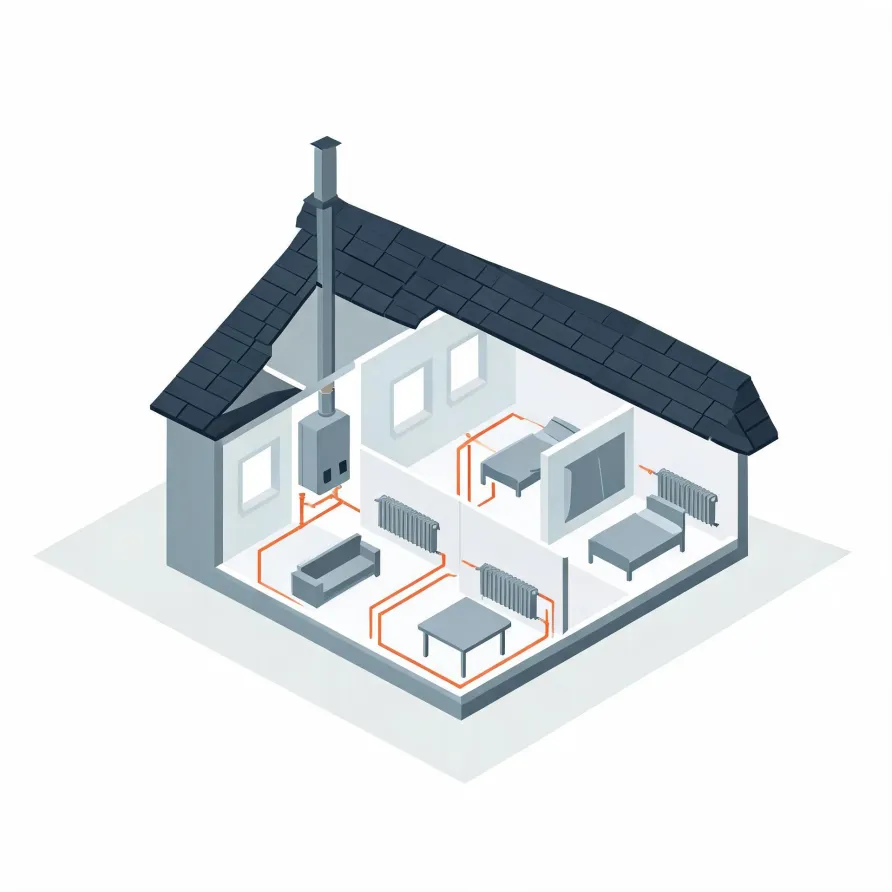
The boiler itself sits in the basement or mechanical room and is the piece a contractor goes to first. It heats water and pushes it through the system. When heat stops reaching the rooms, the problem often lives here, in the burner assembly, the heat exchanger, or the controls that tell the unit when to fire.
Radiators or baseboard convectors sit throughout the living spaces and release heat into each room. Connecting them to the boiler are supply and return pipes, along with the circulator pump that keeps hot water moving. The expansion tank and pressure relief valve sit close to the boiler and are checked whenever the system loses pressure or behaves erratically.
The drawing shows a general layout of a boiler system, and a licensed contractor determines which components apply to your specific installation.
Find a contractor in Cumberland CountyCumberland County, Maine, by the numbers
286 severe weather events were recorded in Cumberland County, Maine between 2015 and 2024.
NOAA National Centers for Environmental Information, Storm Events Database, bulk CSV export, events 2015-01-01 through 2024-12-31.Half the homes in Cumberland County, Maine were built in 1976 or earlier (2020-2024 ACS 5-year).
U.S. Census Bureau, 2020-2024 American Community Survey 5-Year EstimatesCumberland County, Maine holds 153,286 housing units (2020-2024 ACS 5-year).
U.S. Census Bureau, 2020-2024 American Community Survey 5-Year EstimatesOwners occupy 69.8% of the occupied homes in Cumberland County, Maine (2020-2024 ACS 5-year).
U.S. Census Bureau, 2020-2024 American Community Survey 5-Year EstimatesBoiler Repair Rules & Codes for Cumberland County, Maine1 sourced rules and standards
Licensing and Legal Requirements in Cumberland County, Maine
Maine licenses the fuel-burning side of heating rather than HVAC as a trade: a Maine Fuel Board licence is required to install or service solid fuel, oil, propane or natural gas burning equipment, including pellet-fired central heating appliances. Air conditioning is not named anywhere in the chapter.
Weather Stress on Heating Systems in Cumberland County
Boilers work harder when outdoor conditions push against a building's envelope, and Maine winters put that load on the equipment year after year. How much stress a boiler carries over time is a Cumberland County question, not a general one, and local weather history is part of what shapes repair frequency.
286 severe weather events, 2015–2024. Source: NOAA National Centers for Environmental Information, Storm Events Database.